
- Main
- News and events
- Unwanted Furniture Scratching in Cats: How to Humanely Redirect Your Pet and Choose the Right Scratching Post
Unwanted Furniture Scratching in Cats: How to Humanely Redirect Your Pet and Choose the Right Scratching Post
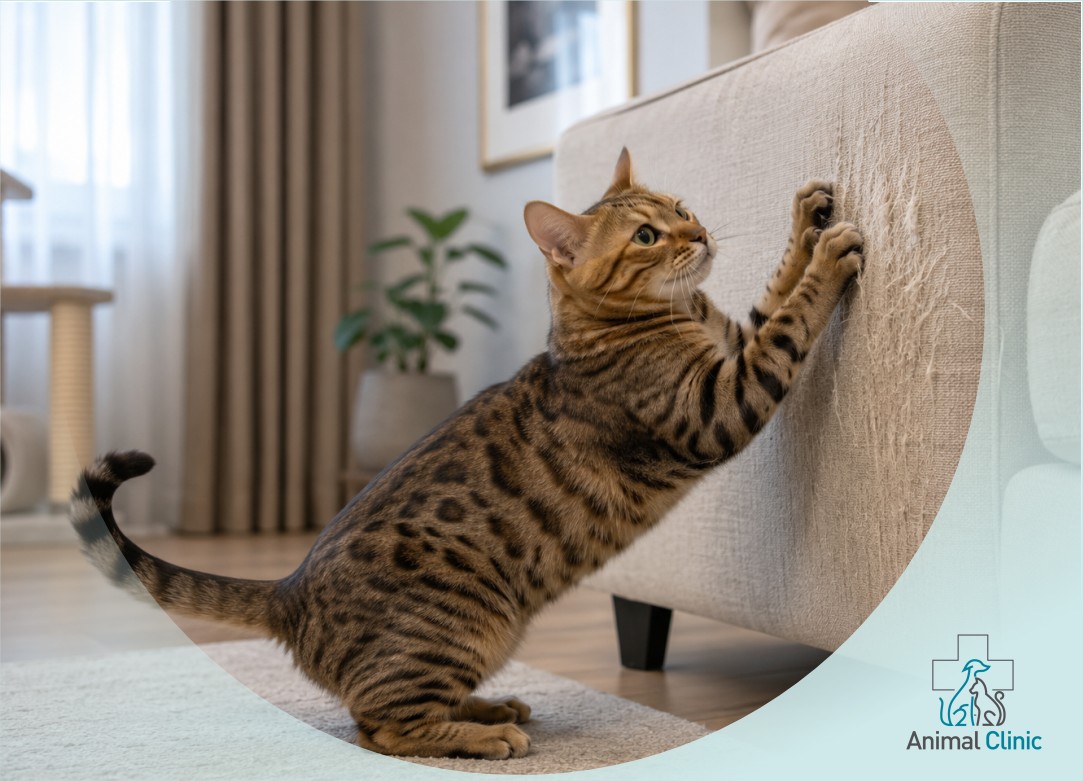
Scratching is a natural, instinctive need in cats that cannot and should not be completely eliminated. However, it can be redirected to appropriate surfaces. When scratching, a cat leaves visual and scent marks using glands in its paw pads, marks its territory, maintains healthy claws, and stretches the muscles of its shoulders and upper body. The owner’s task is to provide an alternative that satisfies these needs without damaging the furniture.
Why cats scratch furniture: instincts that cannot be forbidden
Scratching furniture is not misbehavior or revenge. It is normal behavior for a cat. Scent glands are located in the paw pads, and scratching allows the animal to leave its scent and mark the area as safe. Sofas, armchairs, and beds absorb this scent particularly well because of their soft, porous texture. The second reason is claw maintenance: the old outer layer is shed, revealing new, sharp claws. The third reason is physical stretching: scratching stretches the spine, shoulders, and legs, which is especially important after sleep.
How to stop a cat from scratching furniture: a step-by-step strategy
The main rule is that prohibition without an alternative does not work. The owner’s task is not to forbid natural behavior but to redirect it to appropriate surfaces.
- Temporarily protect your cat’s favorite scratching areas with special anti-scratch tape or other safe furniture protectors to make the surface less appealing.
- Place a scratching post directly next to the area where the cat is used to scratching the furniture. Choose a material your cat likes, such as sisal, jute, or cardboard.
- Encourage the use of the scratching post with play, treats, catnip, or special scratching-post attractants.
- Do not punish your cat, shout at it, or spray it with water. Punishment does not eliminate the cause of the behavior and may cause fear or stress.
- Trim your cat’s claws regularly to reduce the risk of furniture damage and accidental injuries.
Scratching posts for cats: how to introduce one and choose the right type
A scratching post should be stable and tall enough for the cat to stretch to its full length while scratching. It should be placed where the animal spends a lot of time rather than in a rarely visited corner.
Main types:
- Vertical scratching post — made from sisal, jute, or carpet. Suitable for most cats that scratch sofas, walls, or curtains.
- Horizontal scratching pad — made from cardboard or sisal. Suitable for cats that scratch carpets, beds, or floors.
- Corner scratching post — usually made from sisal. Used to protect the corners of furniture or walls.
- Cat activity center with scratching posts — made from a combination of materials. Suitable for active cats that need additional physical activity.
- Cardboard scratching lounger — made from corrugated cardboard. Suitable for cats that enjoy lying down and scratching the same surface.
Alternative methods: claw caps and surgery
Soft silicone claw caps, such as Oni-Gripp or Soft Paws, can temporarily protect furniture from damage. They are attached using a special veterinary adhesive, usually remain in place for 4–6 weeks, and must be replaced regularly as the claws grow.
Claw caps are not equally suitable for every cat, so you should consult a veterinarian before using them.
Onychectomy, or declawing, is not a behavioral correction method and may lead to chronic pain, changes in gait, and behavioral problems. At Animal Clinic, we strongly oppose this procedure and recommend humane alternatives: proper claw care, choosing a suitable scratching post, and consulting a veterinarian specializing in animal behavior.
An environmental approach: enrichment
Boredom and insufficient physical and mental activity can intensify unwanted behavior. Provide plenty of toys, interactive feeders, and activity centers. Install wall-mounted shelves for climbing. Play with your cat for at least 15–20 minutes every day.
The more physical and mental stimulation a cat receives, the less likely it is to engage in destructive behavior. If the problem persists, a veterinarian specializing in behavioral medicine can help determine the cause and create an individual behavior-modification plan.
Frequently asked questions
Can I completely stop my cat from scratching furniture?
The scratching instinct cannot and should not be completely eliminated because it is a natural need. The aim is to redirect the behavior to appropriate surfaces, such as scratching posts, scratching pads, or activity centers. If the cat has access to an acceptable alternative and is rewarded at the right time, it will stop scratching the furniture.
Which scratching post is best for a cat that scratches the sofa?
Because a sofa is a soft vertical surface, the best choice is a tall sisal- or jute-covered post placed next to the sofa. It should be at least 80 cm tall so that the cat can stretch to its full length. If the cat scratches the side of the sofa, try a corner scratching post.
How can I introduce an adult cat to a scratching post if it has never used one?
Place the scratching post or pad horizontally and rub it with dried catnip or apply a pheromone spray. Use treats and play near the scratching surface. If the cat begins scratching the furniture, redirect it to the scratching post instead of punishing it.
Do claw caps help?
In many cases, yes. They are safe and do not interfere with retracting the claws, walking, or jumping. The caps remain in place for 4–6 weeks and then need to be replaced. Most cats become accustomed to them within 1–2 days.
Will my cat damage the curtains if I do not provide a scratching post?
Curtains are a popular target for cats, especially lightweight fabrics that are easy to scratch. If a cat does not have a vertical scratching post, it may choose curtains, wallpaper, or upholstered furniture instead. Placing a tall scratching post near the window often helps solve the problem.
Should I trim my cat’s claws if it uses a scratching post?
Yes. Trimming the claws every 2–3 weeks helps reduce the risk of furniture damage and prevents injuries, such as claws becoming caught in fabric or accidental scratches. A scratching post does not replace hygienic claw trimming. We recommend professional grooming to ensure the procedure is performed safely.
Why does my cat continue scratching furniture even though it has a scratching post?
The scratching post may be placed in an inconvenient or overly exposed location, may be unstable or too short, may be made from an unsuitable material, or the cat may already prefer the texture of the furniture. Try another type of scratching post and place it directly next to the cat’s favorite scratching area.
Can furniture scratching be a symptom of illness?
In rare cases, excessive scratching may be a sign of joint or spinal pain because the cat is attempting to stretch its muscles. If the cat scratches furniture obsessively or for long periods, shows signs of pain, and has become less active, consult a veterinarian for an orthopedic examination.
Do furniture-repellent sprays help?
Sprays with a bitter taste or citrus scent may temporarily discourage a cat, but they do not solve the underlying problem because the animal may begin scratching other surfaces. It is better to apply cat-attracting products containing pheromones or catnip to the scratching post and use repellent sprays on furniture only temporarily while the new habit is being established.
How many scratching posts does one cat need?
A cat needs at least one large scratching post, but it is better to provide 2–3 different types in different rooms. Cats often scratch after sleeping, so place one scratching post near the sleeping area and others near a window and in the hallway along the cat’s main routes around the home.
How can I schedule an appointment for my pet at Animal Clinic?
You can schedule your cat for grooming or a consultation with an animal behavior specialist at Animal Clinic by calling (044) 333 95 63 or (067) 333 95 63. You can also use the appointment form at animalclinic.ua. We will help you choose a convenient time and the appropriate specialist for your pet.