
- Main
- News and events
- Ticks in Autumn: Why You Should Continue Protecting Your Pet After Summer
Ticks in Autumn: Why You Should Continue Protecting Your Pet After Summer
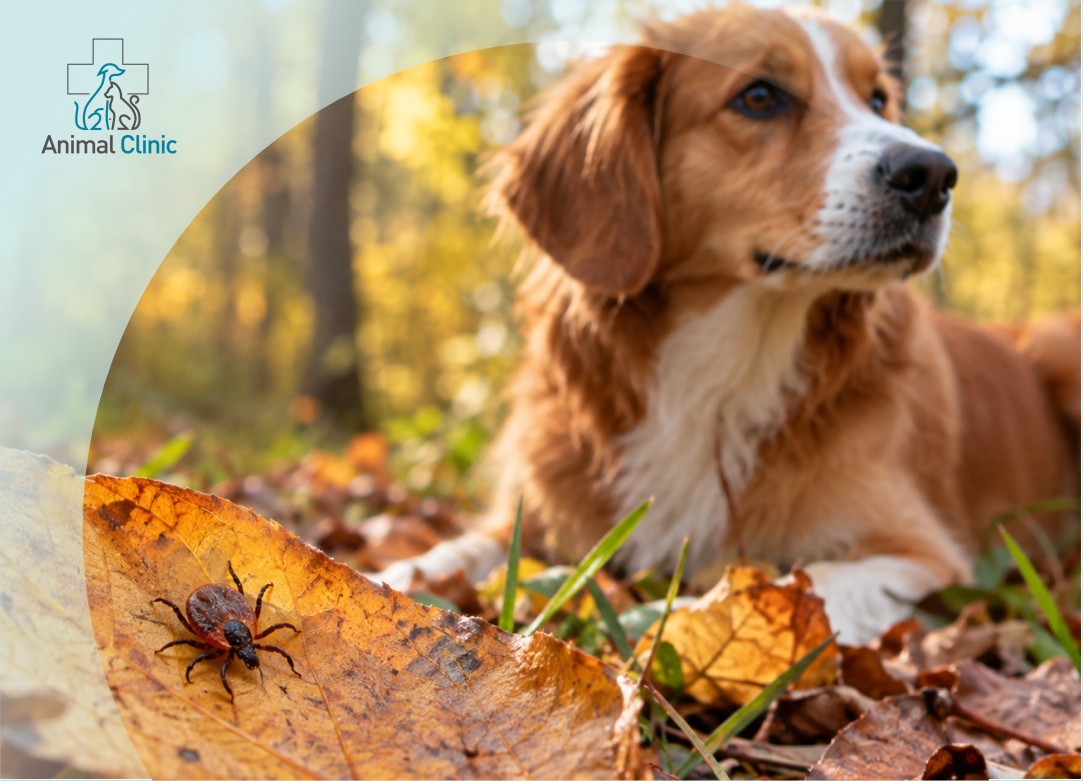
The end of summer does not mean the end of tick season. One of the most common mistakes made by dog and cat owners is stopping parasite prevention when September begins, assuming that cooler weather automatically makes walks safe.
In fact, ticks can remain active in autumn, especially during periods of warm and humid weather. They can be found not only in forests or outside the city, but also in urban parks, public gardens, grass near residential buildings, gardens, and other green areas.
For this reason, the veterinarians at Animal Clinic recommend following a consistent external parasite prevention plan rather than relying only on the calendar.
Why Ticks Remain Active in Autumn
Tick activity depends primarily on weather conditions, humidity, and ambient temperature rather than on a particular date on the calendar.
If the autumn is warm, ticks may continue actively searching for an animal host. Their activity may decrease after cooler days and then rise again during another warm period.
Pets are most likely to encounter ticks:
- in tall grass;
- among bushes;
- in fallen leaves;
- in parks and public gardens;
- in wooded park areas;
- in gardens and on country properties;
- along roadsides and in green areas near buildings.
Therefore, even a short walk in the city does not guarantee complete protection from contact with a parasite.
Why a Tick Bite Is Dangerous for a Dog
A tick bite itself may cause local skin irritation, but the main danger is the potential transmission of infectious and parasitic diseases.
Ticks may transmit pathogens that cause conditions in dogs such as:
- babesiosis;
- anaplasmosis;
- borreliosis;
- other vector-borne diseases.
Not every tick carries an infection, and not every bite causes disease. However, it is impossible to determine this in advance based only on the parasite’s appearance.
That is why the main strategy remains regular prevention of tick bites and careful monitoring of the animal’s condition.
Symptoms After a Tick Bite That Should Not Be Ignored
After finding a tick, carefully monitor your dog’s condition.
Contact a veterinarian if any of the following signs appear after a bite or walk:
- lethargy;
- loss of appetite;
- fever;
- weakness;
- reluctance to walk;
- pale or yellowish mucous membranes;
- changes in urine color;
- vomiting;
- rapid breathing;
- limping;
- unusual behavior.
Do not wait until the symptoms become severe. Some tick-borne diseases may require rapid diagnosis and treatment.
If your dog feels unwell after a tick bite, contact a veterinary clinic as soon as possible.
The Most Common Mistakes Pet Owners Make in Autumn
Mistake No. 1: Stopping Treatment Immediately After Summer
The statement “it is already autumn, so there are no ticks” is a dangerous assumption.
If weather conditions remain favorable, ticks can stay active throughout autumn. Protection should not be stopped simply because the season has changed.
Follow veterinary recommendations, the instructions for the specific product, and your pet’s risk of exposure to parasites.
Mistake No. 2: Failing to Follow the Treatment Interval
Every antiparasitic product has a defined period of effectiveness.
If a product must be administered regularly, delaying the next dose may create a period during which the animal is not adequately protected.
It is useful to set a reminder for the next application immediately after each treatment.
Mistake No. 3: Using the Wrong Dosage
The product should be selected according to:
- the animal’s species;
- body weight;
- age;
- health condition;
- the manufacturer’s recommendations.
Do not divide medication “by eye,” use a dose intended for another weight category, or increase the dosage without veterinary guidance.
It is especially important to remember that some products intended for dogs can be dangerous to cats.
If you are uncertain about choosing a product, consult a veterinarian.
Mistake No. 4: Using Several Products at the Same Time Without Consultation
A collar, spot-on drops, tablets, or a spray may make an owner believe that using more products provides better protection.
However, different antiparasitic products should not be combined without a veterinarian’s recommendation.
Any combination must take into account the active ingredients, mechanisms of action, the animal’s health, and potential risks.
Mistake No. 5: Not Checking the Dog After a Walk
Even when an animal receives parasite protection, it is useful to inspect it after every walk.
Pay particular attention to the:
- head;
- ears;
- neck;
- armpits;
- chest;
- abdomen;
- groin area;
- spaces between the toes.
Examining a long-haired dog may take more time, so carefully work through the coat with your hands.
Mistake No. 6: Trying to Cover the Tick with Oil or Alcohol
If a tick has already attached to the skin, do not try to suffocate it with oil, cream, alcohol, or other substances.
Do not burn the parasite or pull it out abruptly with your fingers.
The tick should be removed carefully with an appropriate tool without crushing or damaging its body. If you are unsure that you can do this correctly, contact a veterinary clinic.
Mistake No. 7: Assuming That Treatment Guarantees There Will Be No Ticks on the Coat
Depending on how the product works, a tick may remain on the coat for some time or may even attach to the animal.
Therefore, using a preventive product does not eliminate the need to inspect your dog after walks.
No preventive method should give an owner a false sense that the risk no longer exists.
How to Protect Your Dog from Ticks in Autumn
Effective prevention requires a consistent approach rather than one isolated action.
1. Do Not Miss Scheduled Treatments
Follow the recommended application interval for the specific product.
2. Select the Product According to Your Pet’s Weight
This is especially important if your dog’s weight has changed since the product was last purchased.
3. Check Your Pet After Every Walk
This is particularly important after visiting parks, forests, areas with tall grass, or country properties.
4. Monitor Your Pet’s Condition
After finding a tick, pay attention to appetite, activity, temperature, and the color of the mucous membranes and urine.
5. Do Not Self-Medicate
Do not give your pet antibiotics, antiparasitic medication, or other drugs “just in case” after a tick bite without a veterinarian’s prescription.
Do Cats Need Tick Protection in Autumn?
Yes. Cats are also at risk, especially if they:
- go outdoors;
- live in a private house;
- travel with their owners to a country property;
- have access to a yard;
- come into contact with other animals.
Cats should receive only products approved for use in their species.
Do not use tick-control products intended for dogs on cats unless specifically instructed by a veterinarian. Some active ingredients used in dog products can be toxic to cats.
What to Do If You Find a Tick on a Dog or Cat
If a tick has attached to the skin:
- calmly restrain the animal;
- use a specialized tick-removal tool or suitable tweezers;
- remove the parasite carefully without squeezing its body;
- inspect the bite site;
- closely monitor the animal’s condition afterward.
If the tick could not be removed completely, the bite site becomes severely inflamed, or the animal’s condition changes, contact a veterinarian.
Tick Prevention in Kyiv: When to Consult a Veterinarian
Owners often search for the “best tick product for dogs.” However, there is no universal product that is equally suitable for every animal.
When selecting protection, the veterinarian considers:
- age;
- weight;
- species;
- lifestyle;
- frequency of walks;
- underlying health conditions;
- previous experience with antiparasitic products.
Veterinary consultation is especially important for puppies and kittens, animals with chronic conditions, pets receiving other medications, or animals that have previously experienced an adverse reaction to antiparasitic products.
If you find a tick, notice changes in your dog’s or cat’s condition, or want to choose an appropriate parasite prevention plan, contact the veterinarians at Animal Clinic.
Regular tick protection is an important part of preventive pet care. Do not stop treatment simply because the calendar summer has ended.
FAQ — Frequently Asked Questions About Ticks in Autumn
Are Ticks Active in September and October?
Yes. In favorable weather conditions, ticks may remain active in September, October, and during other periods of warmer autumn weather. You should not rely solely on the month shown on the calendar.
When Can I Stop Treating My Dog for Ticks?
There is no single calendar date that applies to every animal. The duration of prevention depends on climatic conditions, the dog’s lifestyle, the region, and the specific product. In many cases, a veterinarian may recommend protection for much longer than the summer months.
Can a Dog Pick Up a Tick in Kyiv?
Yes. Ticks may be found in city parks, public gardens, green areas, grass near buildings, and other locations. A dog does not need to visit a forest to encounter a tick.
What Should I Do If a Tick Bites My Dog?
The tick should be removed carefully, and the animal’s condition should be monitored. If the dog becomes lethargic, refuses food, develops a fever, has a change in urine color, or shows other unusual symptoms, contact a veterinary clinic.
Should Tests Be Performed Immediately After a Tick Bite?
The need for testing and the appropriate timing depend on the clinical situation, the possible pathogen, and the animal’s condition. A veterinarian should determine the best approach. Randomly selecting tests immediately after a bite is not always appropriate.
Can I Give My Dog Medication After a Tick Bite as a Preventive Measure?
Do not give antibiotics, antiparasitic medication, or other drugs without a veterinarian’s prescription. Preventive self-medication may be ineffective and create additional risks.
Does a Dog That Walks Only Near the House Need Tick Protection?
Such a dog should also be protected. Ticks may be present in grass, bushes, yards, public gardens, and other urban green areas.
Can a Dog Tick Product Be Used on a Cat?
A dog product must not be used on a cat simply because it targets the same parasites. Some substances that are safe for dogs can be toxic to cats. Choose a product officially approved for use in cats.
Where Can I Take My Dog After a Tick Bite in Kyiv?
You can visit the veterinarians at Animal Clinic locations in Kyiv — in Pozniaky, Osokorky, and Pechersk — and in Sofiivska Borshchahivka. The veterinarian will assess your pet’s condition and determine whether additional tests or treatment are required.